Cross Compliance¶
Path: /frameworks/mapping (sidebar: Compliance > Frameworks >
Cross-framework mapping). The old /cross-compliance path still works and
redirects here.
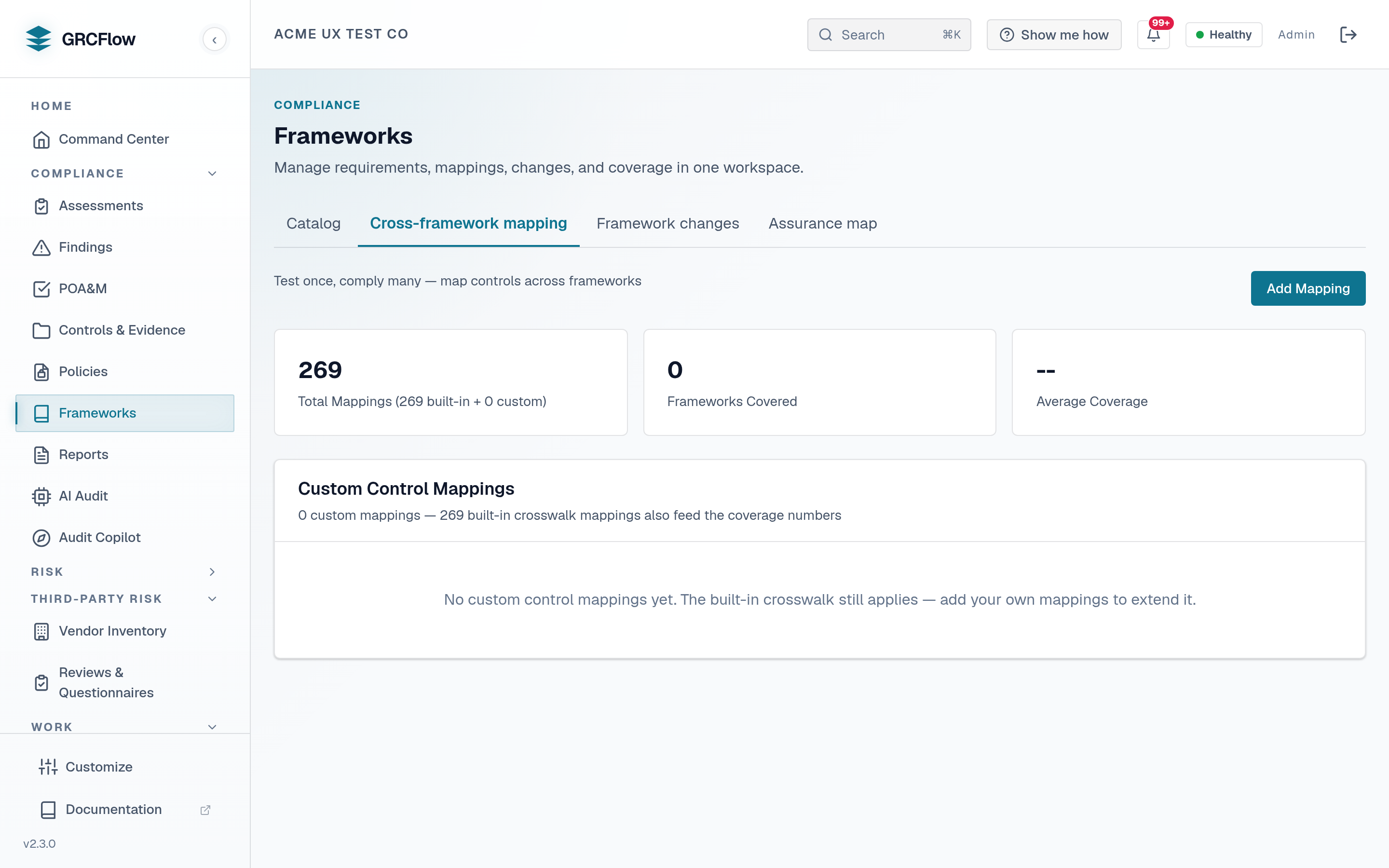
Cross compliance maps controls across different frameworks. If you've already satisfied SOC 2 CC6.1, this shows which ISO 27001, CMMC, and GLBA controls are also covered - so you only test/write once and comply many.
Key Elements¶
- Mapping table - Shows source framework/control mapped to target framework/control.
- Relationship types - Equivalent (fully satisfies), Partial (some overlap), Related (conceptually similar), plus Superset and Subset for broader/narrower coverage. (The API accepts
relationshipas an alias formapping_type.) - Create Mapping - Add your own cross-framework control mappings (persisted per organization).
- Delta analysis - Given a framework you've already done, see exactly what a new framework still requires (the "delta").
- Coverage report - Per-framework coverage percentages computed from the real crosswalk plus your custom mappings (mapped controls that resolve to real catalog controls ÷ the framework's real control count) - never a hardcoded number.
Supported frameworks for mapping¶
Eleven of the 26 frameworks have curated crosswalks (269 built-in mapping rows in this version): SOC 2, ISO/IEC 27001:2022, CMMC Level 2, HIPAA, PCI DSS v4.0.1, NIST CSF 2.0, GDPR, GLBA / FTC Safeguards Rule (16 CFR Part 314), and the three frameworks of the AI-governance pack: ISO/IEC 42001:2023, NIST AI RMF 1.0 and the EU AI Act (46 of the rows map ISO/IEC 42001 to ISO 27001, NIST AI RMF and the EU AI Act).
The other 15 frameworks have no built-in crosswalk rows: NIST SP 800-53 Rev. 5, the three FedRAMP baselines, CMMC Levels 1 and 3, NIST SP 800-171 Rev. 2 and Rev. 3, NIST SSDF, the NIST Privacy Framework, CCPA/CPRA, NYDFS Part 500, DORA, NIS2 and TISAX. For these:
- the mapping table and the coverage report show only the custom mappings you create;
- Framework Delta has no curated rows to report, so apart from your custom mappings every control of the target framework starts as not covered. When an AI provider is configured it can add AI-suggested mappings, each labeled "AI-suggested - verify" with reduced confidence; without one, the result is the crosswalk result alone.
The GLBA content pack covers the required program elements of §314.4(a)–(i): qualified individual, risk assessment, access controls, inventory/data mapping, encryption, secure development, MFA, secure disposal/retention, change management, monitoring & logging, testing, training, service-provider oversight, program evaluation, a written incident response plan, and periodic reporting to the board.
The Delta Engine (reuse gap analysis)¶
Endpoint: POST /api/v1/orgs/{org_id}/cross-compliance/delta
UI: the Framework Delta page at /frameworks/changes
For a customer already doing one framework who now needs another (e.g. an ISO 27001 shop that must also meet GLBA), the delta engine reports, per target control:
target_control- id + title of the framework you now need.mapped_source_controls- the controls from your existing framework that already cover it.coverage-full,partial, ornone.delta- a concrete description of what you still have to write up or implement. Forfull, it tells you which existing evidence to reuse and cite; forpartial, the specific gap to author; fornone, that it must be written from scratch.confidence+source- see honesty labeling below.
It also returns a headline summary:
{
  "total_target_controls": 16,
  "fully_covered": 13,
  "partial": 3,
  "none": 0,
  "reuse_percentage": 90.6
}
reuse_percentage is a weighted score (a fully-covered control counts as 100%
reusable, a partially-covered one as ~50%) - the "you can reuse N% of your ISO
work for GLBA" number.
Request¶
{
  "source_framework": "ISO27001",
  "target_framework": "GLBA",
  "source_assessment_id": null,
  "use_ai": true
}
If you pass an org-scoped source_assessment_id, coverage is refined by which
source controls are actually passing in that assessment (implemented) rather
than merely mapped, and the delta text says whether you can reuse evidence
directly or must implement the source control first.
Honesty: deterministic vs AI-augmented¶
Every result carries a source and confidence so you always know where a
mapping came from:
source: "crosswalk"- the curated, industry-standard crosswalk plus any custom mappings you created. Deterministic and high-confidence. This layer is always available and never depends on an LLM.source: "ai"- for target controls with no crosswalk row, the configured LLM is asked to suggest semantically-similar source controls. These are labeledai, capped at lower confidence, prefixed[AI-SUGGESTED — verify]in the delta text, and must be human-reviewed before use. Any control id the model returns that is not a real control in the source framework is discarded - the engine never fabricates a mapping.
Graceful degradation: if the LLM is disabled, unavailable, times out, or
returns unparseable output, the deterministic crosswalk results are returned
unchanged with an honest note (ai_augmented: false). AI augmentation never
blocks the response and never invents a successful mapping.
How to Use Cross Compliance¶
- Review existing mappings to avoid duplicate audit work.
- Run a delta from a framework you've completed to one you now need to see the reuse percentage and the exact gaps to author.
- Create custom mappings when you identify control overlap the crosswalk doesn't already have - these persist per organization and feed future delta runs.